Showing posts with label seeing. Show all posts

Saturday, November 12, 2011

Observing Galaxies with a 60mm Telescope

This article is part of a series I'm doing on observing with 60mm telescopes. 60mm telescopes are among the most common of first telescopes. My own first telescope was a 60mm which I used for over 10 years, before "moving up" to a 75mm, then over 20 years later to a 200mm telescope. The points in this article are applicable to larger scopes than 60mm, though it is written about 60mm scopes.

In the first article in this series I listed a number of galaxies that can be seen with a 60mm scope. Here I'll cover some of the best, along with tips on how best to observe them with a small telescope.

Conditions for Observing
With a small scope, small things can make a difference between success and failure when observing faint objects. The sky must be right. Low atmospheric moisture levels mean better contrast and more light from the galaxies you want to view. The telescope must be right. It should be in good condition, with clean optics, and most importantly of all, a stable mount that holds the telescope securely on its target, and allows the scope to be moved and pointed easily. The observer should be in a relaxed, unhurried mood.


Bright Galaxies
There are a few galaxies that are bright enough to be seen easily, even with a 60mm telescope. The Andromeda Galaxy, M31, is one of these. In the southern hemisphere the Large and Small Magellanic Clouds are visible to the eye, so they're easy to find and point the scope at. They're also bright enough to show a lot of detail. M31 is too large to fit into the field of view of a normal telescope, but the brightest parts of the halo, the disk part of a spiral galaxy, and the nucleus, the ball of stars at the center of a spiral galaxy, are visible. It is a good observing exercise to see how far from the nucleus of M31 you can go while still being able to tell the halo of M31 from the background sky.

Low powers will give the best contrast in a small telescope like a 60mm. It is more important to be able to make out the galaxy against the background to see it than it is to magnify the detail in them. The higher the level of magnification, the more the light from the galaxy gets spread out, lowering the contrast. The brightest galaxies, like M31, LMC and SMC, M65 and M66 will allow some moderate magnification. Still, they are best viewed at the lowest power possible with the telescope.

If you don't have an eyepiece with a longer focal length than 25mm, you may consider getting one just for observing deep sky objects at low powers with your telescope. either 32mm or 40mm are fairly common. My 40mm eyepiece is my favorite for viewing galaxies, and once it goes into the focuser for the evening, it almost never comes back out.

Dimmer Galaxies
There are many dimmer galaxies visible with a 60mm telescope. Don't expect them to look like the photographs. They'll look like fuzzy gray spots. But they'll have different shapes, brightnesses, and distributions of light across their visible form. Some will have bright centers and dimmer areas around, others will be equally bright all across, others yet will be splotchy or broken into multiple sections.

Near M31 there are two other galaxies, M32 and M110. They are much, much smaller companions of M31, like the LMC and SMC are companions of our galaxy. They are easy to see because they have a high surface brightness. This is the most important determinant for whether a galaxy will be visible in a small scope.

The apparent magnitude is the brightness listed in sky catalogs for galaxies. It's a misleading number, because it is the measure of how much light it would put out if all its light were gathered into one point of light, like a star. But the light is spread out over the whole face of the galaxy.

How much light is put out by any specific part of the galaxy you see is the surface brightness. A galaxy may be bright, but have a low surface brightness. The Triangulum Galaxy, M33, is like this. It is visible in a 60mm scope, but only with difficulty, because any part of it is very dim. Its total light is spread out over a large area of sky. M110 is very bright at any point. It is compact and well defined, making it easy to see compared to M33. So when reading descriptions of galaxies, look for those with a high surface brightness to view with the 60mm scope.

M108 and M109 in the Big Bear both have a high surface brightness. They are spiral galaxies that we see edge-on, so they appear as a short line of light or small lens shape near different parts of the Big Dipper.

M65 and M66 are bright galaxies in the leg of Leo, The Lion, that can be seen together in the same low power field of view. So you can see, and show others, two galaxies at once! There is a third galaxy nearby that's a bit dimmer, but if you can see it, you'll have three galaxies at once.
StumbleUpon

Sunday, November 6, 2011

Observing the Deep Sky with a 60mm Telescope

"Deep Sky" observing is not normally associated with a telescope as small as a 60mm (2.4 inch). There are many nice objects that can be viewed well with a small telescope, however. This is part of a series of articles on this blog about observing with the 60mm telescope. The information also applies to larger scopes, which can get even more out of these objects with their greater observing power.

There are a good number of objects that most any 60mm scope can show well, so long as they have a decent mount. The Lagoon and Trifid Nebulas, the Hercules Cluster, the Great Orion Nebula, the Crab Nebula, and many star clusters are all wonderful objects to show off the abilities of your small scope.

60mm scopes with the highest quality optics and very good mounts can show objects that are usually thought of as objects requiring larger telescopes. Better mounts give a steadier view, and allow you to relax more while looking. Better optics improve the contrast of the image, which makes it easier to find and see the object you're looking for, and to see more of the detail in it.

Star Clusters
Star clusters are the deep sky objects your small scope is most suited for. They are relatively bright, and very numerous, meaning there'll almost always be plenty of them in the sky to choose from. There are two basic types of star cluster, the "open" cluster, which is a general group of stars that happen to be near each other, and the "globular" cluster, which is a group of stars whose mutual gravity has pulled them together into a globe shape.

Both types are visible in your 60mm telesccope. In my first article in this series I listed a good selection of star clusters that can be viewed with a 60mm scope. Here's I'll describe some of my favorites, and observation tips that apply to all clusters.

Globular Clusters
M13, the Great Hercules Cluster, is a showpiece object for northern hemisphere astronomers. It's a big glowing ball of stars in the Keystone of Hercules. Different globular clusters look different. Some have a very even brightness across the face of them, others are brighter at the center then the brightness tapers off as you go outward. M13 is one of these, much brighter at the center. Its brightness drops off regularly from center to edge. Individual stars can be picked out at the edges, with tendril-like streams of stars flowing outward around M13s boundaries.

Compare this with M22, near the top of the Teapot in The Archer, visible to observers north and south. It is about the same brightness as M13 overall, but the bright wash of its center extends well across its diameter. Only the outer parts dim. Southern observers can also enjoy the enormous globular Omega Centauri. M13 and M22 are both visible to the naked eye, but not like Omega Centauri! In the telescope, Omega Centauri shows enough detail to spend a lot of time enjoying it.

Open Clusters
Star Clusters with no particular form are also beautiful in a 60mm. A good night with high contrast skies will show these the best, making more stars visible in the cluster as well as making them stand out clearly from the background sky.

The Beehive Cluster and Alpha Persei Moving Group are beautiful groups of bright yellow stars. As is the case for star clusters in general, they should be viewed at the lowest power you've got for your scope. This would be the eyepiece with the longest focal length. This is the number shown on the eyepiece, usually given in millimeters (mm). Sometimes a viewing angle or other number is listed as well, but the focal length is usually listed most prominently in this case. The one with the largest number gives the lowest power views. For example, a 25mm eyepiece will give lower power magnification than a 15mm eyepiece.

The Seven Sister, or Pleiades (M45) are spread out too far to be seen all at once in nearly all telescopes. But the area can be scanned at low power. About 40-some stars are visible in all under the best conditions, and faint nebulosity (cloudiness) is visible in this area as well.

M39 is a nice, tight cluster at the edge of the area of sky that holds The Swan. It is easily contained in the telescope's field of view, and stands out nicely from its background.

Nebulas
Nebulas are clouds of gas and dust. There are several different sorts. Planetary nebulas are ones that tend toward being round, looking a little like "planets", which is why they have that name. They have nothing to do with planets other than looking a little like the disk that a planet shows. Supernova remnants are clouds of material that have been blown into space by an exploding star. Most commonly seen nebulas are general clouds of gas and dust in the spiral arms of our galaxy. Many of these are places where new stars are being formed, so they are often associated with nearby star clusters.

There are a few bright star clusters that look really good in a 60mm telescope. Most, however, are faint, show little detail, and are very hard to see in a small scope. The Great Orion Nebula near the belt of Orion, and the Lagoon and Trifid Nebulas in The Archer are among the best. On a clear night with a dark sky they show up clearly, with traceries of their gas and dust forming streamers and shapes inside and around them. At their best, they can show a faint greenish color, though they'll usually just show shades of gray in a 60mm.

The Crab Nebula, M1, in Taurus, is a fine supernova remnant for small telescopes. It is relatively easy to find, near the tip of one of The Bull's horns.

Fainter nebulas can be seen as small cloudy shapes. They are a good way to develop your skill as an observer, both in finding them and in observing their form. NGC 6334 lies near the star cluster M6, and is a good starting point for seeking more challenging nebulas.

Many planetaries are very nice to observe in a 60mm scope. Their compact form and well defined edges make them easier to see than a lot of the more "gaseous" looking nebulas.

The Saturn Nebula, NGC 7009, in Aquarius the Water Bearer, is very bright and has a nice green color visible even in small scopes when the sky is good. The Eskimo Nebula, NGC 2392, in Gemini the Twins, is fainter, but its form can be made out easily once found. The Ring Nebula, M57, in Lyra is a favorite of small scope owners. It looks like a smoke ring. It is bright enough to take your scope to its highest magnification, as is the Saturn Nebula.

In the next article I'll cover the final sort of deep sky object you can see with a 60mm: galaxies.
StumbleUpon

Sunday, October 30, 2011

Observing the Moon with a 60mm Telescope

This article is part of a series on using and observing with a 60mm telescope, one of the most common of beginner telescopes. The information also applies to larger scopes, which can show more detail and find objects that are difficult with a 60mm scope more easily.

The 60mm scope can be a very rewarding scope to use, however, especially when getting started. They are compact, often inexpensive, even for quality scopes, and easy to use when well designed. They remain useful even when there are better scopes in the house because of their small size, light weight, and general ease of use.

I used a 60mm scope as my primary telescope for over 10 years. My first scope was a 60mm telescope, unfortunately mated to an extremely poor mount. I fought the mount for many years, if I had been less mule-headed I would have probably given up on astronomy. Fortunately, I finally decided to rebuild my mount using wood from my school's wood shop scrap bin. It looked awful, but held the scope on target and steady. The optics were actually pretty good, once they stayed where they were put.

Observing The Moon
A 60mm is enough scope to enjoy practically everything the Moon has to offer. The craters, valleys, walls, ridges and seas of the Moon will all stand out nicely at low to medium powers (25 to 150 powers). If your telescope has a clock or computer drive you will also be able to use higher powers on the Moon (150 to 250 powers). It is one of the few objects that is bright enough for high powers for a small telescope. But it will be a lot harder to get a sharp focus and to stay on your target at higher powers.

The best place to look on the Moon's surface for nice detail is near the dividing line between night and day on the Moon. This is where the contrast is the sharpest. Plus, you can see changes as time passes in these places. One of my favorite things to do is find a crater where the rim is in sun, but the floor is still in darkness. Sometimes, every so often, I can watch the Sun illuminate the central peak of a crater as I watch. It'll go from darkness to a sudden spot of light in the middle of the crater. Other times I'll look at an area, go look at other things elsewhere, then come back an hour or so to see if anything has changed in areas I've looked at earlier in the night.

Many parts of the Moon will be too bright to show much detail, or will be so bright in the telescope that it'll ruin your night vision. In this case the little Moon filters that come with many telescopes, designed to be fitted to the eyepiece, can be helpful in cutting the light down to a more tolerable level and help bring out some contrast. Unlike the little solar filters, these are safe to use. If a Moon filter didn't come with your telescope, there are many color and "neutral density" filters available that you can get inexpensively.

Neutral density filters are strictly "black and white" filters that cut down brightness without changing the colors of what you're looking at. They are my favorite for using on the Moon, especially when I'm looking for color on the Moon. One sort is a polarizing filter, which can be adjusted to different darkness levels. These are also useful for seeing cloud details on Venus, but they tend to be expensive.

Color filters also work well on the Moon. Darker colors often come in packs of different color filters that are commonly sold. About the only object these darker filters are useful on is the Moon. Dark red, orange, green, and yellow filters will each have a different effect.

Light color filters are nice for bringing out detail in areas of the Moon where there is some color in the soil. These colors are very faint, and the filter will eliminate the ability to see the colors directly, but they will bring out more detail of the surface in these areas.

Be careful of trying to take the magnification too high. It's tempting on the Moon, but more detail will actually be seen at moderate powers by relaxing (a couple of deep breaths are always good) and taking the time to let the subtle details of the image "sink in" as you view.
StumbleUpon

Sunday, October 23, 2011

Observing the Sun and Planets with a 60mm Telescope

In What Can I See With a 60mm Telescope I gave brief lists of some of what you can observe with a 60mm telescope, with just the briefest of notes on hoow to do that observing. Now I'll cover some of the details of how best to observe the objects mentioned in this and subsequent articles.

First, the Sun and the planets. The Moon and the various deep sky objects are large enough subjects that I'll cover them by themselves elsewhere.

Magnification

You can use both medium and low magnification on the planets when observing them. They are bright enough that even with a 60mm telescope you can enlarge the image with magnification and still see some detail where there's detail to be seen. Each planet observable with a 60mm scope is detailed below.

For a 60mm scope, low magnifications range from about 20 powers (or 20 diameters, if you prefer), to about 100 powers. Medium levels of magnification are the highest practical magnification levels for this size scope. A 60mm will not allow what is typically referred to as "high" power magnification. Medium powers run from about 100 powers to about 200 powers. Anything more in this size scope will result in such a loss of detail and contrast that you'd actually see more at lower powers.

If your scope has eyepieces that claim to give higher levels of magnification, take them out of your usual kit of stuff you take observing with you and set them aside for another telescope. You'll get the best views from your 60mm at magnifications from 40 to 120 powers, the scope is usable up to 150 powers or so, and can be used at up t0 200 powers if everything about the scope and the sky is perfect. Higher levels of magnification are theoretically possible, but are, in practice, show far less than lower powers.

Mount
In this size range of telescope, the mount is actually far more important than the optics of your scope. Most optics in this range are pretty good. The finest optics and best designed 60mm telescope will show far more, of course! But to show anything the mount must be able to hold the scope steady and on the object you've pointed it at.

Plus, to observe using higher powers (over about 120-150x), the mount will have to have either good slow motion controls or a clock or computer drive. Mounts without these will work perfectly well at the lower powers, my mount for my 60mm has no drive or slow motion controls.

First and foremost, though, the mount has to hold the scope still. It shouldn't slide down or up when locked in place. It shouldn't shift halfway across the sky when the position is locked in. It should be possible to thump the scope lightly and not have it move off target.

There are many 60mm telescopes sold with good mounts today. There are also very, very many sold with the awful mounts of yesteryear that frustrated the heck out of me. The best thing I ever did with my 60mm scope was build a new mount that actually held it in place. You can do even better, by getting a good mount that works well right from the start. If you can get one with either a drive mechanism or with slow motion controls, that's nice. If not, don't fret. You can do a lot of observation with even the simplest stable mount.

The Sun
The Sun is only safe to view if you have a solar filter that fits over the front of the telescope. The sort that goes on the eyepiece is not safe to observe with, they will overheat and crack. If somebody's eye is there when that happens, that eye will be blinded forever by the damage from the concentrated sunlight. I have literally had one of these filters crack just as I looked away from the eyepiece. Don't trust the little eyepiece sun filters, not even for a moment. If one came with your scope, throw it away before you are tempted to give it a try.

If you do have a proper filter, your scope will show you the surface of the Sun, including any sunspots visible on it. You can watch the sunspots move as the Sun turns. They are most interesting to watch as they appear and disappear at the edges of the Sun.

Rarely, either Mercury or Venus will pass between the Earth and the Sun. This is called a transit. Usually it can only be seen from a particular part of the Earth that's lined up right. But, if you have a properly outfitted 60mm telescope for solar observation, and you're in the right place at the right time with nothing blocking your view, you can observe a transit with your telescope.

More common is a solar eclipse, where the Moon passes between us and the Sun. A telescope fitted for solar observation can also be used to watch a solar eclipse close-up.

Mercury
Mercury appears as a small orange-red disk in a 60mm telescope. It doesn't show any detail, but its color will change depending on the sky conditions you observe it under. It is always near the Sun, so it can only be observed near sunrise or sunset. Sometimes it can be seen during the daytime, but it is so close to the Sun that it's not really safe to observe without the chance of accidentally moving the telescope onto the Sun.


Venus
Venus appears as a small, bright, Moon-like object. It shows phases, and can be magnified to the limit of your scope's ability. Rarely, cloud detail can be viewed in a 60mm with a variable polarizer filter, though it usually takes a larger telescope to manage this.

The phases of Venus are quite distinct, looking just like phases of the Moon.

Venus can be observed safely in the daytime when it is far away from the Sun, at or near what is called "greatest elongation" which is astronomer-speak for farthest it gets from the Sun. Be very, very careful when locating it, however. Initially align your telescope without your eye at the eyepiece or the finder scope, using the shadows cast by the Sun to make sure that the scope isn't pointing at the Sun. Then, sweep away from the Sun, never toward it. If you need to go back closer to the Sun, take your eye away from the scope or the finder, move the scope while watching the shadows, don't put any body parts in line with the eyepiece (the Sunbeam that comes out of it will burn), better yet, cover the objective of the telescope when going back toward the Sun. Then again sweep away from the Sun.

When seen during the day, Venus looks like a little Moon as seen during the daytime.

Mars
Mars shows some surface detail, unlike Mercury and Venus. It will show light and dark areas at medium power. A polar cap is visible, especially when the position of Mars and its season is right, when the polar cap may cover about 1/4 of the visible planet's disk. Mars has an especially nice display about once every two years, when it is closest to the Earth.

Its two moons are too small to be seen, even in much larger telescopes, so don't expect to find them. If you see something nearby, it's likely a background star, or possibly an asteroid if it appears to move rapidly with respect to Mars (rapidly meaning about as fast as a clock's hand!)

Color filters can bring out subtle detail in Mars' surface when Earth is close enough to make Mars look its largest (it never, never gets as large as the Moon, however! That's just an internet myth.) Light colored filters work the best, I use very light yellow and blue filters, and occasionally a very light orange filter, to bring out details of light and dark areas on the surface of Mars at about 200-250 powers when everything--sky, mount, telescope, my eyes--are at their best.

Ceres and the Bright Asteroids
About a dozen asteroids are visible to a 60mm scope in any given year. Finder charts for them are online and in the major astronomy magazines and their annual supplements. None of them shows the form of a disk, they all appear as stars, at best.

They are most interesting to observe when you can watch them from night to night, seeing the movement of the "star" relative to the other stars near it.

Rarely, there will be an asteroid that is rotating at a rate that makes it brightness change as you watch. These are incredibly interesting to see, as it is so rare, and such a clear sign that that "star" is not like the others.

Jupiter
Jupiter is one of the things that your 60mm scope was built to view. It is a showpiece for your scope. It's what you show visitors so that they can say, "Wow," when they look through your scope.

Jupiter will show bands in its atmosphere, even at low powers. If the Great Red Spot isn't busy blending in with its background, it will be visible at the highest powers your scope can achieve (sometimes it's more visible than others.) It was very obvious back in the 1970s and 1980s, but then it began to dim and fade in with the cloud belt it is in. Now it is becoming somewhat more visible again. Hopefully it will continue to do so. Back in the 1970s it looked like a great big cherry, standing out clearly from its cloud belt even in a 60mm scope.

Larger scopes often have to block off some of the excess light from Jupiter when it is at it brightest. You are unlikely to have that problem with a 60mm. You should be able to see at least two dark bands, one above and one below, as well as the dark areas at each pole easily. That makes seven stripes (four dark, three light) that you should be able to see, even with so-so optics. Fine, high quality optics show far more, including far more detail within each of the bands such as veils, columns, rifts, bays, garlands, tails, festoons, and numerous other features. This is why people pay more for better optics, even in small scopes.


Jupiter's Moons
The four Galilean Moons will be easily visible through the 60mm scope. They will appear as small stars in line with Jupiter's equator. Occasionally, their shadows can be seen on Jupiter's surface, or they can be seen to cross in front of Jupiter if you have good optics. Their movement changes noticeably over the course of an evening, but if you just sit and watch them it's like watching the hour hand move, so memorize where they are, go look at something else, then come back for another look later.

Saturn
Saturn is probably the best object to see in your 60mm telescope. My wife still tells the story of how she "discovered" Saturn in her 60mm telescope when she was young.

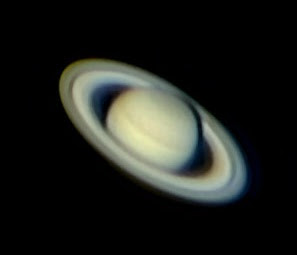
The planet is bright, the rings are easy to see at 40x and higher. Careful observation with a relaxed eye will show bands in the atmosphere of the Saturn. The angle of the rings varies over time. When the rings are "open", that is, tilted at a higher angle and not edge-on, the Cassini division is visible in the rings. Better optics will show other divisions and more detail in the rings.

The moon Titan shows easily in all 60mm scopes. It appears as a bright star near Saturn. Four, and possibly as many as six, other moons will be visible. Seeing all seven moons that are possible with the 60mm requires absolutely perfect conditions and the highest quality optics. Normally, Titan will be easy, and two to four other moons will be visible with varying levels of difficulty.

Uranus
Uranus appears as a small disk, often with a faint greenish color to it when it is at its brightest. None of its moons are visible, nor are any details of its surface. Low powers show it the best, and throwing the image slightly out of focus may reveal color when none is visible otherwise.

Neptune
Neptune appears as a very small disk at the higher powers for your scope. When at its brightest, it may show a slight blue color. No detail is visible on the disk. This is a challenging object to observe with a 60mm scope, it is often very hard to tell Neptune from nearby stars. No moons are visible.
StumbleUpon

Saturday, October 15, 2011

What Can I See With a 60mm Telescope?

60mm telescopes are among the most common and most popular. They are inexpensive, generally, don't take up too much space, and easy to come by. Most of them have optics that range from decent to good, with a few very good models out there. 60mm is enough light gathering power to enjoy a lot of different objects in the sky.

I used a 60mm scope as my main telescope for over 10 years before "moving up" to a 75mm reflector. During that time I learned how to get the most out of my telescope as my abilities advanced and I learned both more about the sky and more about using a telescope. My wife still owns a 60mm telescope, and though our household has many larger scopes, it still comes out to the front yard or back porch on occasion for casual observing sessions. It's light, easy to use, and enough telescope for many objects in the sky.

The thing that holds a lot of these smaller scopes back, especially at the low end of the price range, are poor mounts. But, if you can put your scope on target and get it to stay there, here are some of the sights you can expect to enjoy with your 60mm (2.4 inch) telescope.

In this article I'll be covering a brief list of what you can see with a 60mm telescope, which may be far more than you'd expect for such a modest aperture. There are a few objects that are downright magnificent, even with such a small scope. These are the brighter objects, where the mere 60mm of light collecting power is not a disadvantage. Most objects will have much more subtle detail, however, and will require more patience at the eyepiece to appreciate fully.

There are also objects that the challenge of observing them at all in such a small instrument is part of the fun. Collecting star clusters, globular clusters, or galaxies observed in a 60mm telescope can be a rewarding occupation all on its own. Plus, if you have the opportunity to use a larger telescope, you are already skilled at finding challenging objects, and can see your old friends with far greater detail.

Here are some of the things you can see with a 60mm telescope. Subsequent articles go into more detail about observing each of the different types of objects with your small scope. These objects are also good in larger telescopes that gather more light. They'll usually be easier to locate and will show more detail in larger scopes.

The Moon
Craters, mountains, seas, rifts, valleys, searching for colored areas on the Moon. The 60mm scope turns the Moon from a bright object in the sky into a world whose terrain you can explore.

The Sun
Use only a full-aperture filter over the front of the telescope. Never use one of the little eyepiece solar filters! You can observe sunspots, transits when they occur, and eclipses.

The Planets
Mercury, Venus, Mars, Ceres, Jupiter, the Galilean Moons of Jupiter, Saturn and its rings, Titan and four other moons of Saturn (possibly as many as seven moons total under perfect conditions!), Uranus, Neptune. Jupiter and Saturn are two of the finest showpieces in the sky for the 60mm scope.

Saturn and its rings

Other Solar System Objects
Typically about a dozen asteroids will be bright enough on any given year to be seen with a 60mm telescope. Also, usually two or three comets appear that can be seen, sometimes more.

The Stars
Stars are the forte of the 60mm telescope aside from the Moon, Jupiter, and Saturn. In particular, double and triple stars and the brighter, tighter star clusters. Mizar and Alcor in the Big Dipper make a good start for northern hemisphere observers, then zooming in on Mizar to see both Mizar and its companion, Mizar B. Just to the south of Alcor and Mizar lays double star Cor Caroli in the Hunting Dogs. Leo contains several nice double stars for observers in both hemispheres, and there are many, many more spread throughout the sky.

When observing individual stars and double stars you will be able to take your telescope to its highest practical magnification levels, about 150 to 200 powers if you have a good mount and either a clock drive or good slow motion controls on an equatorial mount. Otherwise, you will still get plenty of good observing at magnifications of about 50-100 powers. More on this is later articles.

Colored Stars
Most stars appear pretty well white. But some have a distinctive color. Herschel's Garnet Star in The Charioteer is a star that shows its color most strongly in small telescopes. In larger scopes the color begins to "wash out". It is a bright red in a small scope, becomes amber in a larger scope, and finally a watery yellow in the largest amateur telescopes. The double star Albireo in The Swan is a pair of stars of differing colors, each one setting off the color of the other, one yellow, one blue. The Red White and Blue triplet in The Swan is another close group where the color of each sets off the colors of the others. There are many nice colored stars in many constellations.

Star Clusters
When observing star clusters you will usually want to view with the lowest possible magnifications for your telescope to see as much of the sky at once as you possibly can. Many 60mm telescopes come with eyepieces that give far too much magnification for the aperture of the scope, but they don't come with eyepieces that allow the scope to work at the incredibly useful low levels of magnification they are capable of. Eyepieces of 35mm and 42mm and thereabouts make great "sky sweeping" eyepieces, and are the sort of thing you want for most "deep sky" objects.

There are many star clusters you can enjoy with the 60mm telescope. Some are too large to see all at once but can be "swept" to be enjoyed. There are two basic types of star cluster. The "open" cluster and the "globular" cluster. The globular cluster looks like a globe of stars. Open clusters vary from ones that look almost exactly like globulars to loose groups of stars that are near each other.

Here are some you can see in your 60mm:
Double Cluster in Perseus, M13 the Great Hercules Cluster, M103, M7, M6, M39, M22 the Arkenstone, M70, M54, NGC 6242, NGC 6281, M80, M4, M2, M5, NGC 6231, M45 The Seven Sisters, M11, M17, M62, M55, M28, M54, M69, M75, M26, NGC 6664, NGC 6712, NGC 6649, and many more. If that sounds like a lot of gobblety-gook, it's because I've mostly just given the "short" name of the cluster, which is a catalog number. Most of these are from the Messier catalog (the M numbers), a great list of objects to observe with a small telescope.

Deep Sky Objects
Star clusters are one type of "deep sky object", which is basically anything that isn't a solar system object or an individual star or star system (in the case of double, triple, and other multiple star systems.) You can see galaxies, nebulas (space clouds) and other things with your 60mm as well.

Galaxies:
M31, M110, M32, M33, M65, M66, M51, M101, M108, M109.

Planetary nebulas are roundish clouds of dust and gas thrown off by some stars:
M27 The Dumbbell Nebula, NGC 40, NGC 246, NGC 1535, NGC 2392 The Eskimo Nebula, NGC 3132, NGC 3242, NGC 6210, NGC 6543, NGC 6572, NGC 6826, NGC 7009 The Saturn Nebula, NGC 7662, M57 The Ring Nebula.

Other nebula don't have any particular type of shape:
North America Nebula, Pelican Nebula, The Great Orion Nebula, M8 The Lagoon Nebula, M20 The Trifid Nebula, Rho Ophiuschi, NGC 6334, and many more, particularly near the Milky Way.

Dark nebulas are dark clouds of gas and dust that are often outlined by bright objects behind them. There is a dark nebulosity about 2 degrees south of M62, Barnard 86 is a dark nebula in The Archer in the Milky Way. There are many others, in Orion and elsewhere, that you can see.

Star clouds are areas of our own galaxy that are especially rich in stars. They are too large to be seen all at once through the scope, but they make impressive areas of the sky to sweep through with the 60mm telescope. M11 The Scutum Star Cloud, in The Shield, is the largest and most impressive but sweeping along the length of the Milky Way at the lowest power possible will turn up many areas where your view will be filled with countless stars.

In future articles I'll give more details and tips on observing these different types of objects with the small telescope. If you've got a larger scope than 60mm, remember, you can see these objects, too, and in more detail.
StumbleUpon

Monday, August 9, 2010

How to See Through Your Telescope

When I take my telescope to star parties, to show off the sky to the public, I get two types of people at the scope. One type of attendee approaches the scope, darts their eye toward the eyepiece, then is away again almost immediately.

"Did you see it?" I'll ask.

"Yeah, I saw it," they'll say as they buzz away, as if they're in a hurry to get somewhere.

Yet they'll have been at the eyepiece so briefly that they'll not really have even had a chance for their eye to focus properly. They've glanced at the image like a quick glance at a picture in a book. They saw the light, but not the object itself. They didn't give themselves a chance to see whatever it was I had in the scope, its shape, color, or any detail. Even when I know what I'm looking at, I can't really see it that fast.

The second type of viewer takes their time. They allow their eye to adapt to the view through the scope. Looking at an image in a telescope is not like looking at a TV screen, or a book, or at something that we see without any assistance in front of our eyes. It takes a moment for our eyes to adapt. The second type of viewer gives their eye a chance to adapt to the view.

They actually get to see what's in the scope.

When the object I'm presenting has fine detail to it, I make suggestions to the viewers who are willing to take the time to really look. I ask them if they can see some specific detail, to give them an objective. "Can you see the light yellow bands on Saturn?" "Can you see the dim star just below the brighter star? It's hard to see in the glare of the brighter star." "Can you see the dark area just below the bright nucleus?" And so on. Then I tell them to take their time to allow their eye to relax, since a relaxed eye is more sensitive to detail.

Learning to See All Over Again

When you're learning to use a new telescope, really taking time to learn to see is important to getting the most out of your scope. A lot of it is simple experience, coming from looking at many different objects and types of objects. Part of it is using good practices, giving yourself a chance to get better at it. With time, you'll find that you learn to see more of what you look at. You'll see more detail, and see more of what distinguishes one object from another. The galaxies won't all just look like "gray fuzzies" any more. You'll be able to make out the weather patterns on planets, and so on.

The Downside

The downside to this is that you may find that you notice flaws with your telescope that you didn't notice before. There are some instruments that this may never happen with, the fine ones at the top of the market, for example. But even some of these will show imperfections if they're of a sort that need adjustments to the optical train, like a Newtonian reflector.

Many telescope flaws are easily fixable. But with some telescopes the limitations may be something you can't overcome. In some cases, you may simply find that the scope, while fine for some types of observing, no longer fits your preferences for the type of observing you do.

Remember how I've recommended not to bet everything on your first telescope? This is why. No matter how good your first telescope is, it may not end up fitting your preferences that develop as your observing experience grows. Also, a scope that looks optically perfect to an untrained eye may look very different to a more experienced eye later on.

So be prepared to have your taste in telescopes change. Don't worry, it's a good thing.

Give Your Eye A Chance

Here are some practical things to do to allow yourself to get better views through your scope:

  • Allow yourself to look long enough at each object.
  • Make it so that you can relax while you observe.
  • Read other observer's reports, so you have specific details to look for.
  • Try observing the same object under different conditions, either by using filters or different magnifications during one session, or on different observing sessions at different times of year or under differnt sky conditions.
  • Observe reasonably often, if possible. You "forget" if you go too long between observing sessions. If you can do a number of sessions over a short period of a few weeks, then go without for a while, you'll get more than from the same number of sessions spaced out widely in time.
StumbleUpon
Add to Technorati Favorites