Showing posts with label nebula. Show all posts

Saturday, November 12, 2011

Observing Galaxies with a 60mm Telescope

This article is part of a series I'm doing on observing with 60mm telescopes. 60mm telescopes are among the most common of first telescopes. My own first telescope was a 60mm which I used for over 10 years, before "moving up" to a 75mm, then over 20 years later to a 200mm telescope. The points in this article are applicable to larger scopes than 60mm, though it is written about 60mm scopes.

In the first article in this series I listed a number of galaxies that can be seen with a 60mm scope. Here I'll cover some of the best, along with tips on how best to observe them with a small telescope.

Conditions for Observing
With a small scope, small things can make a difference between success and failure when observing faint objects. The sky must be right. Low atmospheric moisture levels mean better contrast and more light from the galaxies you want to view. The telescope must be right. It should be in good condition, with clean optics, and most importantly of all, a stable mount that holds the telescope securely on its target, and allows the scope to be moved and pointed easily. The observer should be in a relaxed, unhurried mood.


Bright Galaxies
There are a few galaxies that are bright enough to be seen easily, even with a 60mm telescope. The Andromeda Galaxy, M31, is one of these. In the southern hemisphere the Large and Small Magellanic Clouds are visible to the eye, so they're easy to find and point the scope at. They're also bright enough to show a lot of detail. M31 is too large to fit into the field of view of a normal telescope, but the brightest parts of the halo, the disk part of a spiral galaxy, and the nucleus, the ball of stars at the center of a spiral galaxy, are visible. It is a good observing exercise to see how far from the nucleus of M31 you can go while still being able to tell the halo of M31 from the background sky.

Low powers will give the best contrast in a small telescope like a 60mm. It is more important to be able to make out the galaxy against the background to see it than it is to magnify the detail in them. The higher the level of magnification, the more the light from the galaxy gets spread out, lowering the contrast. The brightest galaxies, like M31, LMC and SMC, M65 and M66 will allow some moderate magnification. Still, they are best viewed at the lowest power possible with the telescope.

If you don't have an eyepiece with a longer focal length than 25mm, you may consider getting one just for observing deep sky objects at low powers with your telescope. either 32mm or 40mm are fairly common. My 40mm eyepiece is my favorite for viewing galaxies, and once it goes into the focuser for the evening, it almost never comes back out.

Dimmer Galaxies
There are many dimmer galaxies visible with a 60mm telescope. Don't expect them to look like the photographs. They'll look like fuzzy gray spots. But they'll have different shapes, brightnesses, and distributions of light across their visible form. Some will have bright centers and dimmer areas around, others will be equally bright all across, others yet will be splotchy or broken into multiple sections.

Near M31 there are two other galaxies, M32 and M110. They are much, much smaller companions of M31, like the LMC and SMC are companions of our galaxy. They are easy to see because they have a high surface brightness. This is the most important determinant for whether a galaxy will be visible in a small scope.

The apparent magnitude is the brightness listed in sky catalogs for galaxies. It's a misleading number, because it is the measure of how much light it would put out if all its light were gathered into one point of light, like a star. But the light is spread out over the whole face of the galaxy.

How much light is put out by any specific part of the galaxy you see is the surface brightness. A galaxy may be bright, but have a low surface brightness. The Triangulum Galaxy, M33, is like this. It is visible in a 60mm scope, but only with difficulty, because any part of it is very dim. Its total light is spread out over a large area of sky. M110 is very bright at any point. It is compact and well defined, making it easy to see compared to M33. So when reading descriptions of galaxies, look for those with a high surface brightness to view with the 60mm scope.

M108 and M109 in the Big Bear both have a high surface brightness. They are spiral galaxies that we see edge-on, so they appear as a short line of light or small lens shape near different parts of the Big Dipper.

M65 and M66 are bright galaxies in the leg of Leo, The Lion, that can be seen together in the same low power field of view. So you can see, and show others, two galaxies at once! There is a third galaxy nearby that's a bit dimmer, but if you can see it, you'll have three galaxies at once.
StumbleUpon

Sunday, November 6, 2011

Observing the Deep Sky with a 60mm Telescope

"Deep Sky" observing is not normally associated with a telescope as small as a 60mm (2.4 inch). There are many nice objects that can be viewed well with a small telescope, however. This is part of a series of articles on this blog about observing with the 60mm telescope. The information also applies to larger scopes, which can get even more out of these objects with their greater observing power.

There are a good number of objects that most any 60mm scope can show well, so long as they have a decent mount. The Lagoon and Trifid Nebulas, the Hercules Cluster, the Great Orion Nebula, the Crab Nebula, and many star clusters are all wonderful objects to show off the abilities of your small scope.

60mm scopes with the highest quality optics and very good mounts can show objects that are usually thought of as objects requiring larger telescopes. Better mounts give a steadier view, and allow you to relax more while looking. Better optics improve the contrast of the image, which makes it easier to find and see the object you're looking for, and to see more of the detail in it.

Star Clusters
Star clusters are the deep sky objects your small scope is most suited for. They are relatively bright, and very numerous, meaning there'll almost always be plenty of them in the sky to choose from. There are two basic types of star cluster, the "open" cluster, which is a general group of stars that happen to be near each other, and the "globular" cluster, which is a group of stars whose mutual gravity has pulled them together into a globe shape.

Both types are visible in your 60mm telesccope. In my first article in this series I listed a good selection of star clusters that can be viewed with a 60mm scope. Here's I'll describe some of my favorites, and observation tips that apply to all clusters.

Globular Clusters
M13, the Great Hercules Cluster, is a showpiece object for northern hemisphere astronomers. It's a big glowing ball of stars in the Keystone of Hercules. Different globular clusters look different. Some have a very even brightness across the face of them, others are brighter at the center then the brightness tapers off as you go outward. M13 is one of these, much brighter at the center. Its brightness drops off regularly from center to edge. Individual stars can be picked out at the edges, with tendril-like streams of stars flowing outward around M13s boundaries.

Compare this with M22, near the top of the Teapot in The Archer, visible to observers north and south. It is about the same brightness as M13 overall, but the bright wash of its center extends well across its diameter. Only the outer parts dim. Southern observers can also enjoy the enormous globular Omega Centauri. M13 and M22 are both visible to the naked eye, but not like Omega Centauri! In the telescope, Omega Centauri shows enough detail to spend a lot of time enjoying it.

Open Clusters
Star Clusters with no particular form are also beautiful in a 60mm. A good night with high contrast skies will show these the best, making more stars visible in the cluster as well as making them stand out clearly from the background sky.

The Beehive Cluster and Alpha Persei Moving Group are beautiful groups of bright yellow stars. As is the case for star clusters in general, they should be viewed at the lowest power you've got for your scope. This would be the eyepiece with the longest focal length. This is the number shown on the eyepiece, usually given in millimeters (mm). Sometimes a viewing angle or other number is listed as well, but the focal length is usually listed most prominently in this case. The one with the largest number gives the lowest power views. For example, a 25mm eyepiece will give lower power magnification than a 15mm eyepiece.

The Seven Sister, or Pleiades (M45) are spread out too far to be seen all at once in nearly all telescopes. But the area can be scanned at low power. About 40-some stars are visible in all under the best conditions, and faint nebulosity (cloudiness) is visible in this area as well.

M39 is a nice, tight cluster at the edge of the area of sky that holds The Swan. It is easily contained in the telescope's field of view, and stands out nicely from its background.

Nebulas
Nebulas are clouds of gas and dust. There are several different sorts. Planetary nebulas are ones that tend toward being round, looking a little like "planets", which is why they have that name. They have nothing to do with planets other than looking a little like the disk that a planet shows. Supernova remnants are clouds of material that have been blown into space by an exploding star. Most commonly seen nebulas are general clouds of gas and dust in the spiral arms of our galaxy. Many of these are places where new stars are being formed, so they are often associated with nearby star clusters.

There are a few bright star clusters that look really good in a 60mm telescope. Most, however, are faint, show little detail, and are very hard to see in a small scope. The Great Orion Nebula near the belt of Orion, and the Lagoon and Trifid Nebulas in The Archer are among the best. On a clear night with a dark sky they show up clearly, with traceries of their gas and dust forming streamers and shapes inside and around them. At their best, they can show a faint greenish color, though they'll usually just show shades of gray in a 60mm.

The Crab Nebula, M1, in Taurus, is a fine supernova remnant for small telescopes. It is relatively easy to find, near the tip of one of The Bull's horns.

Fainter nebulas can be seen as small cloudy shapes. They are a good way to develop your skill as an observer, both in finding them and in observing their form. NGC 6334 lies near the star cluster M6, and is a good starting point for seeking more challenging nebulas.

Many planetaries are very nice to observe in a 60mm scope. Their compact form and well defined edges make them easier to see than a lot of the more "gaseous" looking nebulas.

The Saturn Nebula, NGC 7009, in Aquarius the Water Bearer, is very bright and has a nice green color visible even in small scopes when the sky is good. The Eskimo Nebula, NGC 2392, in Gemini the Twins, is fainter, but its form can be made out easily once found. The Ring Nebula, M57, in Lyra is a favorite of small scope owners. It looks like a smoke ring. It is bright enough to take your scope to its highest magnification, as is the Saturn Nebula.

In the next article I'll cover the final sort of deep sky object you can see with a 60mm: galaxies.
StumbleUpon

Saturday, October 15, 2011

What Can I See With a 60mm Telescope?

60mm telescopes are among the most common and most popular. They are inexpensive, generally, don't take up too much space, and easy to come by. Most of them have optics that range from decent to good, with a few very good models out there. 60mm is enough light gathering power to enjoy a lot of different objects in the sky.

I used a 60mm scope as my main telescope for over 10 years before "moving up" to a 75mm reflector. During that time I learned how to get the most out of my telescope as my abilities advanced and I learned both more about the sky and more about using a telescope. My wife still owns a 60mm telescope, and though our household has many larger scopes, it still comes out to the front yard or back porch on occasion for casual observing sessions. It's light, easy to use, and enough telescope for many objects in the sky.

The thing that holds a lot of these smaller scopes back, especially at the low end of the price range, are poor mounts. But, if you can put your scope on target and get it to stay there, here are some of the sights you can expect to enjoy with your 60mm (2.4 inch) telescope.

In this article I'll be covering a brief list of what you can see with a 60mm telescope, which may be far more than you'd expect for such a modest aperture. There are a few objects that are downright magnificent, even with such a small scope. These are the brighter objects, where the mere 60mm of light collecting power is not a disadvantage. Most objects will have much more subtle detail, however, and will require more patience at the eyepiece to appreciate fully.

There are also objects that the challenge of observing them at all in such a small instrument is part of the fun. Collecting star clusters, globular clusters, or galaxies observed in a 60mm telescope can be a rewarding occupation all on its own. Plus, if you have the opportunity to use a larger telescope, you are already skilled at finding challenging objects, and can see your old friends with far greater detail.

Here are some of the things you can see with a 60mm telescope. Subsequent articles go into more detail about observing each of the different types of objects with your small scope. These objects are also good in larger telescopes that gather more light. They'll usually be easier to locate and will show more detail in larger scopes.

The Moon
Craters, mountains, seas, rifts, valleys, searching for colored areas on the Moon. The 60mm scope turns the Moon from a bright object in the sky into a world whose terrain you can explore.

The Sun
Use only a full-aperture filter over the front of the telescope. Never use one of the little eyepiece solar filters! You can observe sunspots, transits when they occur, and eclipses.

The Planets
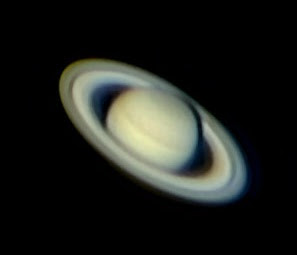
Mercury, Venus, Mars, Ceres, Jupiter, the Galilean Moons of Jupiter, Saturn and its rings, Titan and four other moons of Saturn (possibly as many as seven moons total under perfect conditions!), Uranus, Neptune. Jupiter and Saturn are two of the finest showpieces in the sky for the 60mm scope.

Saturn and its rings

Other Solar System Objects
Typically about a dozen asteroids will be bright enough on any given year to be seen with a 60mm telescope. Also, usually two or three comets appear that can be seen, sometimes more.

The Stars
Stars are the forte of the 60mm telescope aside from the Moon, Jupiter, and Saturn. In particular, double and triple stars and the brighter, tighter star clusters. Mizar and Alcor in the Big Dipper make a good start for northern hemisphere observers, then zooming in on Mizar to see both Mizar and its companion, Mizar B. Just to the south of Alcor and Mizar lays double star Cor Caroli in the Hunting Dogs. Leo contains several nice double stars for observers in both hemispheres, and there are many, many more spread throughout the sky.

When observing individual stars and double stars you will be able to take your telescope to its highest practical magnification levels, about 150 to 200 powers if you have a good mount and either a clock drive or good slow motion controls on an equatorial mount. Otherwise, you will still get plenty of good observing at magnifications of about 50-100 powers. More on this is later articles.

Colored Stars
Most stars appear pretty well white. But some have a distinctive color. Herschel's Garnet Star in The Charioteer is a star that shows its color most strongly in small telescopes. In larger scopes the color begins to "wash out". It is a bright red in a small scope, becomes amber in a larger scope, and finally a watery yellow in the largest amateur telescopes. The double star Albireo in The Swan is a pair of stars of differing colors, each one setting off the color of the other, one yellow, one blue. The Red White and Blue triplet in The Swan is another close group where the color of each sets off the colors of the others. There are many nice colored stars in many constellations.

Star Clusters
When observing star clusters you will usually want to view with the lowest possible magnifications for your telescope to see as much of the sky at once as you possibly can. Many 60mm telescopes come with eyepieces that give far too much magnification for the aperture of the scope, but they don't come with eyepieces that allow the scope to work at the incredibly useful low levels of magnification they are capable of. Eyepieces of 35mm and 42mm and thereabouts make great "sky sweeping" eyepieces, and are the sort of thing you want for most "deep sky" objects.

There are many star clusters you can enjoy with the 60mm telescope. Some are too large to see all at once but can be "swept" to be enjoyed. There are two basic types of star cluster. The "open" cluster and the "globular" cluster. The globular cluster looks like a globe of stars. Open clusters vary from ones that look almost exactly like globulars to loose groups of stars that are near each other.

Here are some you can see in your 60mm:
Double Cluster in Perseus, M13 the Great Hercules Cluster, M103, M7, M6, M39, M22 the Arkenstone, M70, M54, NGC 6242, NGC 6281, M80, M4, M2, M5, NGC 6231, M45 The Seven Sisters, M11, M17, M62, M55, M28, M54, M69, M75, M26, NGC 6664, NGC 6712, NGC 6649, and many more. If that sounds like a lot of gobblety-gook, it's because I've mostly just given the "short" name of the cluster, which is a catalog number. Most of these are from the Messier catalog (the M numbers), a great list of objects to observe with a small telescope.

Deep Sky Objects
Star clusters are one type of "deep sky object", which is basically anything that isn't a solar system object or an individual star or star system (in the case of double, triple, and other multiple star systems.) You can see galaxies, nebulas (space clouds) and other things with your 60mm as well.

Galaxies:
M31, M110, M32, M33, M65, M66, M51, M101, M108, M109.

Planetary nebulas are roundish clouds of dust and gas thrown off by some stars:
M27 The Dumbbell Nebula, NGC 40, NGC 246, NGC 1535, NGC 2392 The Eskimo Nebula, NGC 3132, NGC 3242, NGC 6210, NGC 6543, NGC 6572, NGC 6826, NGC 7009 The Saturn Nebula, NGC 7662, M57 The Ring Nebula.

Other nebula don't have any particular type of shape:
North America Nebula, Pelican Nebula, The Great Orion Nebula, M8 The Lagoon Nebula, M20 The Trifid Nebula, Rho Ophiuschi, NGC 6334, and many more, particularly near the Milky Way.

Dark nebulas are dark clouds of gas and dust that are often outlined by bright objects behind them. There is a dark nebulosity about 2 degrees south of M62, Barnard 86 is a dark nebula in The Archer in the Milky Way. There are many others, in Orion and elsewhere, that you can see.

Star clouds are areas of our own galaxy that are especially rich in stars. They are too large to be seen all at once through the scope, but they make impressive areas of the sky to sweep through with the 60mm telescope. M11 The Scutum Star Cloud, in The Shield, is the largest and most impressive but sweeping along the length of the Milky Way at the lowest power possible will turn up many areas where your view will be filled with countless stars.

In future articles I'll give more details and tips on observing these different types of objects with the small telescope. If you've got a larger scope than 60mm, remember, you can see these objects, too, and in more detail.
StumbleUpon
Add to Technorati Favorites